

Complexity Metrics
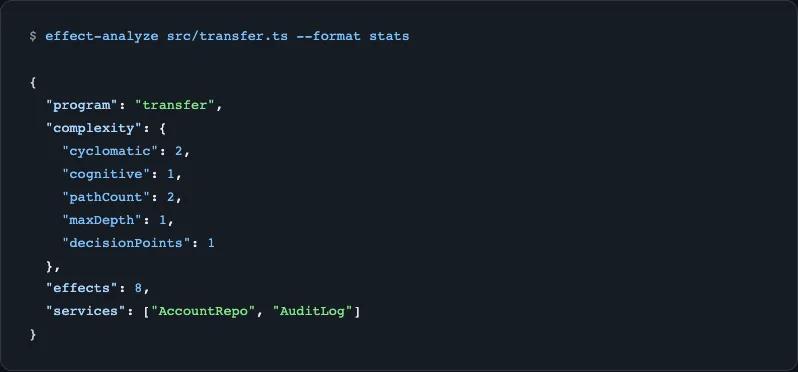
effect-analyzer calculates six complexity metrics for every Effect program it analyzes. Use these metrics to identify programs that may be difficult to understand, test, or maintain.
The Six Metrics
Section titled “The Six Metrics”| Metric | Description |
|---|---|
cyclomaticComplexity | Number of linearly independent paths through the program (McCabe). Each conditional, race branch, and loop adds 1. |
cognitiveComplexity | How hard the program is for a human to understand (Sonar-style). Penalizes nesting and non-linear flow more heavily than cyclomatic. |
pathCount | Total number of distinct execution paths. Returns a number, or 'unbounded' if loops make enumeration infinite. |
maxDepth | Maximum nesting depth of the IR tree. Deep nesting indicates complex control flow. |
maxParallelBreadth | Largest number of concurrent branches in any Effect.all or Effect.race call. |
decisionPoints | Total number of branching points (conditionals, race arms, loops). |
Calculating Complexity
Section titled “Calculating Complexity”npx effect-analyze ./src/transfer.ts --format statsThis prints all six metrics along with analysis metadata (step count, service count, error types).
Library API
Section titled “Library API”import { analyze, calculateComplexity } from "effect-analyzer"import { Effect } from "effect"
const ir = await Effect.runPromise(analyze("./src/transfer.ts").single())const metrics = calculateComplexity(ir)
console.log(metrics)// {// cyclomaticComplexity: 3,// cognitiveComplexity: 4,// pathCount: 2,// maxDepth: 2,// maxParallelBreadth: 0,// decisionPoints: 1,// }Assessing Severity
Section titled “Assessing Severity”Use assessComplexity to evaluate metrics against configurable thresholds and get actionable recommendations:
import { calculateComplexity, assessComplexity } from "effect-analyzer"
const metrics = calculateComplexity(ir)const assessment = assessComplexity(metrics)
console.log(assessment.severity)  // 'low' | 'moderate' | 'high' | 'critical'console.log(assessment.warnings)  // Array of specific warnings
Each warning includes a metric, value, threshold, and human-readable message.
Default Thresholds
Section titled “Default Thresholds”| Threshold | Value |
|---|---|
cyclomaticWarning | 10 |
cyclomaticError | 20 |
pathCountWarning | 50 |
maxDepthWarning | 5 |
Override thresholds by passing a second argument:
const assessment = assessComplexity(metrics, { cyclomaticWarning: 15, cyclomaticError: 30, pathCountWarning: 100, maxDepthWarning: 8,})Formatting a Summary
Section titled “Formatting a Summary”Use formatComplexitySummary to produce a human-readable string:
import { calculateComplexity, formatComplexitySummary } from "effect-analyzer"
const metrics = calculateComplexity(ir)const summary = formatComplexitySummary(metrics)
console.log(summary)// Cyclomatic: 3 | Cognitive: 4 | Paths: 2 | Depth: 2 | Parallel: 0 | Decisions: 1
Understanding the Metrics
Section titled “Understanding the Metrics”Cyclomatic Complexity
Section titled “Cyclomatic Complexity”Counts the number of linearly independent paths. A program with no branches has cyclomatic complexity 1. Each if, match arm, race branch, or loop adds 1.
Guidelines:
- 1-5: simple, easy to test
- 6-10: moderate, manageable
- 11-20: complex, consider refactoring
- 21+: very complex, refactor into smaller programs
Cognitive Complexity
Section titled “Cognitive Complexity”Measures how hard the code is to understand, not just how many paths exist. Unlike cyclomatic complexity, cognitive complexity:
- Penalizes nesting - an
ifinside aloopinside agenscores higher - Penalizes non-linear flow - error handlers that re-enter the main flow
A program can have low cyclomatic complexity but high cognitive complexity if it uses deeply nested structures.
Path Count
Section titled “Path Count”The total number of distinct execution paths. This is the product of all branching factors in the program. A program with two conditionals each having two branches has 4 paths.
When the program contains loops without a fixed bound, the path count is reported as 'unbounded'.
Max Depth
Section titled “Max Depth”The maximum nesting level of the IR tree. A flat sequence of yields has depth 1. Wrapping that in an Effect.gen inside an error handler inside a conditional increases depth.
Max Parallel Breadth
Section titled “Max Parallel Breadth”The largest number of concurrent branches. Effect.all([a, b, c], { concurrency: "unbounded" }) has breadth 3. Programs without parallel operations have breadth 0.
Decision Points
Section titled “Decision Points”The raw count of all branching nodes in the IR (conditionals, race arms, loops). This is a simpler measure than cyclomatic complexity - it counts branches without computing path independence.
Related
Section titled “Related”- Execution Paths - enumerate all paths through a program
- Test Coverage Matrix - generate test cases from paths
- Strict Diagnostics - lint rules based on complexity